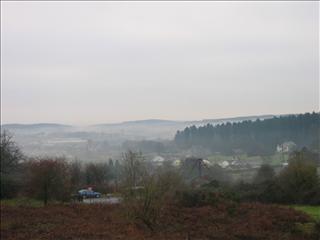
 At 10:00 we parked up in the church car park in Quarry Hill, Nailbridge. As we walked the few yards to where the tracks would have run under the road it was easy to see that this would have been quite an industrial area. To the north the line ran up through what is now Hale's timber yards. and came out of the rear of the property via a bridge that carried the road above. A well worn track and a broken fence saw us stay on course until a farmer came to remind us that this was not a public right of way. We played dumb and engaged him in a chat about the railway. He was a pleasant enough chap, but was too young to give me any information. He was under the impression that the track ran further down the field as there was a visible line there, but this was wrong as all the maps showed. We found the nearest road via a wooden track / bridge which crossed a bog. Bob got a shock when he ran through the wet grass and found he was up to his neck in water. This was the beginning of today's struggle to stay on the track. We passed a house called Harry Hill View.








peterdean.co.uk
Nailbridge - Drybrook - Lea

 At 10:00 we parked up in the church car park in Quarry Hill, Nailbridge. As we walked the few yards to where the tracks would have run under the road it was easy to see that this would have been quite an industrial area. To the north the line ran up through what is now Hale's timber yards. and came out of the rear of the property via a bridge that carried the road above. A well worn track and a broken fence saw us stay on course until a farmer came to remind us that this was not a public right of way. We played dumb and engaged him in a chat about the railway. He was a pleasant enough chap, but was too young to give me any information. He was under the impression that the track ran further down the field as there was a visible line there, but this was wrong as all the maps showed. We found the nearest road via a wooden track / bridge which crossed a bog. Bob got a shock when he ran through the wet grass and found he was up to his neck in water. This was the beginning of today's struggle to stay on the track. We passed a house called Harry Hill View.
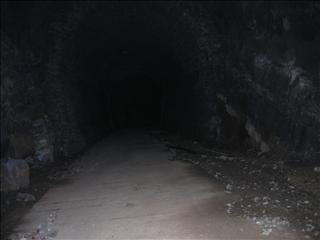 We had to follow the roads of Drybrook before coming to the point where we met up with the track again. Another bridge saw the exit of the field, with the track several yards below, but the other side of the bridge was raised. I don't think there's a tunnel here. Maybe the land has been filled. A house was being built directly above where the track would have been. The field was being worked by two hands, so I'll have to check back another day. At last we found the railway cutting next to a public footpath. We didn't have to follow it for too long before coming to Drybrook Tunnel. It looked open, then as you get closer you realize that there's a brick wall 50 feet into the tunnel. Someone had tried to force open the iron door, but to no avail. Pieces of industrial junk lay around. We'd plotted the point where the north portal lay, which was thankfully in the forest, so we set off to find it. You need to be a little careful when approaching the tunnel as you may find yourself dropping from above the entrance if you're not on the ball.
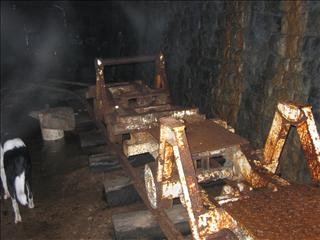 The woods here are very beautiful and I can't imagine they are used much. The wall lay 50 feet into the tunnel again, but this time the door was open. After changing the torch batteries we set off into the tunnel. It's the first tunnel where I've noticed a distinct incline. As is often the case, some sections are brick lined and then there's a rock section. Most of the floor had been covered with a smooth concrete layer, making walking very easy. A 10 foot room could be entered in the middle of the tunnel via a small arched doorway. As we go close to the end there were narrow gauge tracks with some decrepit old trucks. This definitely wasn't the original track. There was also cable, pots and machinery, but it was pretty tidy on the whole. By the time we'd walked back to the north portal we'd walked a mile underground. We stopped for a drink and enjoyed the peace. Heading north we had a nice easy stretch through forest. It didn't last long though, and we found ourselves climbing through brambles and trees. We walked sections alongside the track as it was such hard work. The track itself stood on a raised ridge.
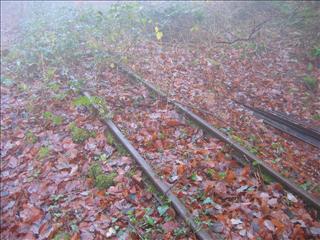 Things cleared again and the now well defined path passed under a diagonal stone bridge and then on to an area with loads of railway paraphernalia. The first thing I noticed was a good section of track. This has been pretty hard to find until now. There were a number of wagons, trucks and piled up sleepers too. Last, but not least was what appeared to be a tunnel entrance, though it wasn't facing the direction of the track. Two doors securely barred my entrance. Inside was no more than a small cave, presumably used for storage of trucks, as the rails ran into the cavern. We pressed on. A garage stood between us and where were needed to go, but we were on raised ground and it's corrugated roof was at floor level. A reinforced pathway had been constructed, so I crossed carefully, though Bob just ran across. I had visions of him crashing through the roof, but he's pretty light fortunately. The farm house was very close, but the fog gave good cover and we felt quite safe. After the next field we were forced down the back of gardens to a point where we could go no further without attracting attention. Besides, a gaggle of geese were making a real racket. You've got to know when to quit.
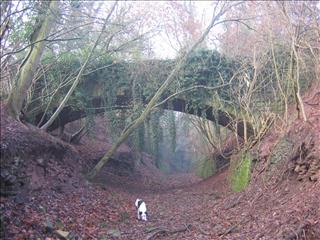 We hopped another fence and got back onto the road, which passed between two sides of a bridge. The top was no longer there. A Forest of Dean boundary stone stood in the garden next to the bridge. The track went through a farm, so we stuck to the road until we got to a public footpath and crossed a field to meet the track once more. This was the junction where the line went west to Ross and east to Gloucester. We hadn't planned going west here, but the cutting was so nice that we walked it for a while. Well, about a field or twos length until it climbed back up to the level of the surrounding land and became nothing special. In this short stretch there was another lovely bridge with a shallow arch passing over the track. We retraced our steps to the junction and climbed a fence into an unused thicket to the side of the field. Most of tracks we've come across have nothing at all growing where they stood, but this stretch was totally overgrown. We had a really tough job getting through, but we knew there would be a fair amount of track round here that we wouldn't be able to follow, so we had to make the most of any bits that were possible.
 A short stretch of field, followed by a muddy path revealed cows blocked the way to a few new houses. We were pretty sure we would not get past the houses so went back to the road. After a fair diversion we arrived at the other side of the houses. A building was signed Lea Station. No way through was possible. This was becoming a pain. The problem was that we were out of the forest and the land was open, private and arable. We decided to just enjoy the next couple of miles and forget about the track. I sat on a stile on the edge of a wood to eat lunch. You couldn't see half way across the field due to the fog. It was strangely peaceful. I think I would like to have lived in the days when these railways still ran. The world must have been a quieter, slower, more relaxed place.
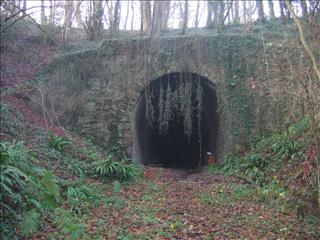
We crossed the A40 near Lynors Farm and picked up the scent once more. We were looking for a tunnel entrance as we came down the edge of the hill. We found it alright, but the steep embankments made it hard to get down there. We had to be careful as there was a house nearby too. The portal was completely open, with no attempt to block it. We hadn't seen many of these.
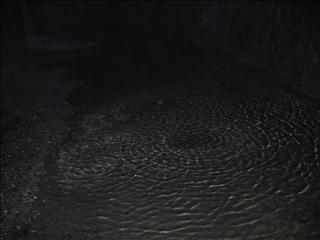 This was the wettest tunnel we had encountered. The floor of the east half was mostly covered in water, though you could generally dodge the water. I had good boots on as always, so it wasn't a problem. The other unusual thing about this tunnel was that it was perfectly straight. You could see the daylight at the other end, even though it was mainly blocked. This gave the impression that it was shorter than it really was. In fact it was very close to 0.5 miles long. Air bricks let in light at the westerly end, but several had been removed and were only blocked by a few piled up rocks. We could have emerged, but it was getting dark and we had a long way to go to get home. The GPS had already gone beep as it picked up the satellite signal through the wall, but I stuck it through the gap to get a more accurate reading. We walked back via the light of the mini maglite, for what would be the last time as it turned out that I'd got a cool Petzl head torch for Christmas. We had fun scrambling up the embankment. At first we just kept sliding back down, so had to find an easier route. We climbed up, found our way back to the road and completed the 16 mile journey down the Wysis Way in the fog, then darkness. Great fun, but hard work.